


Source is a registered trademark.
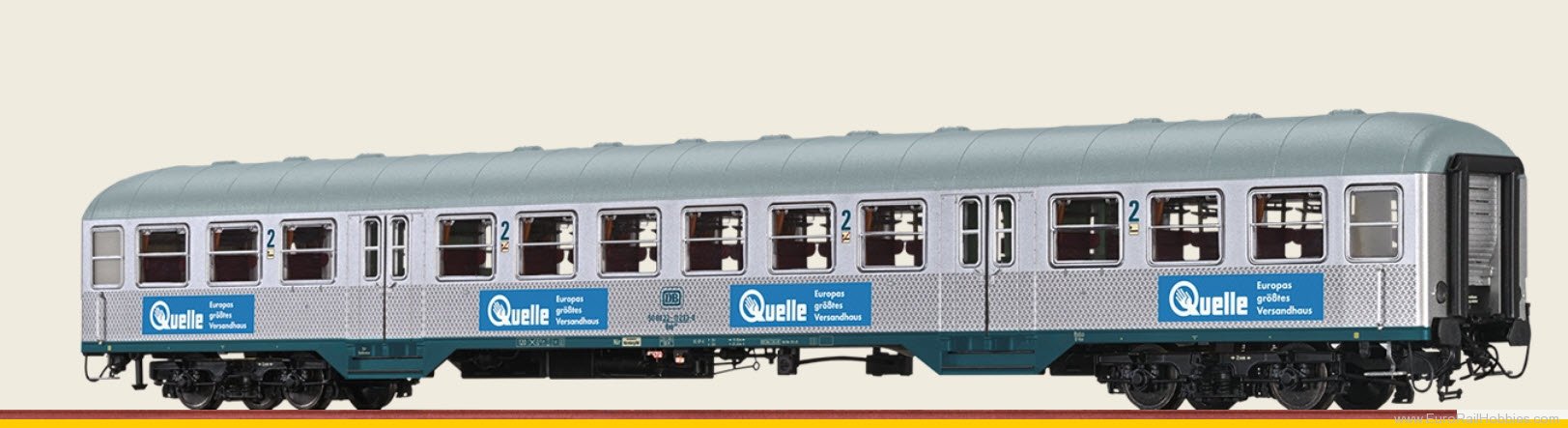
With the conversion programmes for 3yg and 4yg coaches, the Deutsche Bundesbahn was able to counteract the war-related wagon shortage from the mid-1950s onwards for the first time. However, the new construction programmes were initially limited to the development of urban express transport and express train coaches. It was only after this that the Bundesbahn had the capacity to develop new local transport coaches (n-wagons). The steadily growing demand for traffic volumes and the fact that the 3yg in particular were only designed for a short service life led to the first prototypes of the new n-cars in 1958. Based on the findings of the previous new developments and the prototypes, the three basic types were created with 5 1st class compartments in the middle of the car and two 2nd class open spaces (AB4nb), three 2nd class large rooms (B4nb) and two 2nd class large rooms and luggage compartments with driver''s cab (BD4nf). While the prototypes had been experimented with side panels made of aluminum, normal steel and also corrugated side walls, it was finally decided to use stainless steel (V2A) sheet metal for series production. Since the painting of the cars could be omitted as corrosion protection on this material, the n-cars were sanded below the windows with a so-called peacock eye pattern. This cut pattern, in combination with the silver surface of the V2A, quickly earned the n-cars the distinctive nickname "Silberlinge". With a few exceptions, the n-cars were equipped with Minden-Deutz bogies lightly equipped with block brakes (MD42), which gave way to disc brakes (MD43) in later series. In order to change passengers as quickly as possible, the usual end entrances were dispensed with and arranged on thirds of cars as double entrances with swing trap doors. The basic design of the n-cars proved so successful that between 1960 and 1980 a total of around 5000 cars were built by various wagon manufacturers but also by the repair shops (Aw) Karlsruhe and Hanover. Initially, the space conditions in the very cramped driver''s cabs of the BD4nf were not quite optimal, which quickly got the nickname "rabbit box" among the personnel and led to resentment and safety concerns. As a consequence, the Aw Karlsruhe redesigned the driver''s cab in such a way that in 1972 a control car with a full-fledged driver''s cab was created without the possibility of transition to the next car. Due to these changes, the Karlsruhe head differs greatly from the previous rabbit box with the end of the wagon transition. From the mid-1980s, the Bundesbahn began to modernize the cars, some of which were already over 20 years old. After several design studies, the advantages of the individual programs were combined at the Aw Hannover to form the new Design Hannover. Other new ingredients were the paint job in mint green or new transfer windows with plastic frames. This design, which was also installed with other interior colours by PFA Weiden or OFV Verona, can still be found today in the n-coaches, which have now been painted in the current corporate identity of DB AG. Further modifications again concerned the control cars. The two designs presented so far were only suitable for either diesel or electric traction by changing the control table. A new driver''s cab was therefore designed at Aw Wittenberge, based on the DB standard driver''s cab of the BR 111, in order to be able to use the control cars more freely. Numerous old rabbit boxes and also Karlsruhe heads were then converted into Wittenberg heads. In order to meet the need for more push-pull trains, DB AG also included normal 2nd class coaches in the conversion programme.

Mon-Fri:


