


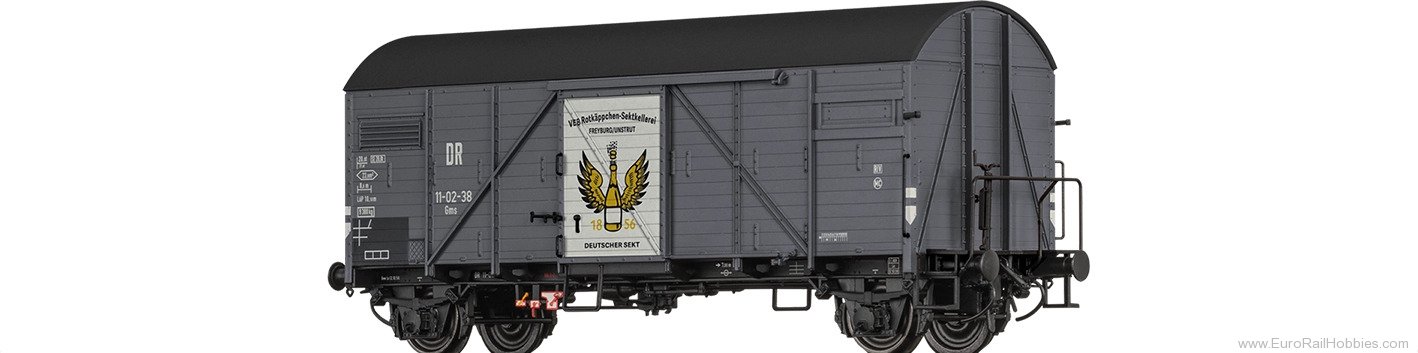
Little Red Riding Hood is a registered trademark.
The Rotkäppchen sparkling wine cellar has its origins in 1856 in Freyburg an der Unstrut. Founded by the brothers Moritz and Julius Kloss together with their friend Carl Foerster, Sektkellerei Kloss und Foerster specialized in the production of sparkling wines. Due to a new law in 1894, the iconic red capsule became the new brand name. "Rotkäppchen Sekt" became one of the first German trademarks to be registered and still exists today. Today, the company is part of the Rotkäppchen-Mumm Group and stands for tradition, quality and enjoyment. The Deutsche Reichsbahn was constantly striving to expand and renew its vehicle fleet. The successor to the Gms Opole can therefore be seen as the Gm(h)s Bremen. Following the state of the art, the Gm(h)s Bremen were manufactured in welded construction from 1943 onwards and were given an extremely long axle base of 7 m in order to achieve the desired smoothness of the vehicles. In addition, 260 mm high longitudinal beams were used for the first time, but they could be made lighter and save a total of about 25% of the costs compared to the predecessor design, the Gms Opole. The exact number of cars delivered by the end of the war is not known. However, based on existing inventory lists, it can be assumed that at least 7,230 pieces remained with various state railways. The headquarters of the Reichsbahn in the British-US zone had the production of Gm(h)s 35 resumed in 1949 with new orders, new freight wagons were needed quickly due to the numerous war losses in order to be able to cope with the emerging transport volumes. In terms of design, there were small changes compared to the original design. The most striking were certainly the now vertical strut on the loading door and the omission of the diagonals on the front side. By the end of 1950, 5,925 more Gm(h)s had been added to the fleet of the Deutsche Bundesbahn (DB). The Deutsche Reichsbahn of the Soviet zone resumed production at the end of 1945 and classified it as Gmhs 11. The Reichsbahn thus came to a total of about 800 cars of this type. A large part of the cars were modernized at the RAW Magdeburg from 1967 onwards. The cars were fitted with UIC charging and fan sliders, were sheeted in the upper third of the side walls, fitted with sheet metal roofs and converted to wheelsets with roller bearings.

Mon-Fri:


